Agricultural spray drones are giving farmers and land managers a more precise way to apply chemicals across difficult or sensitive landscapes.
For this New Zealand project, Pro Vision used drone spraying technology to target unwanted vegetation within a 10-hectare paddock while applying spray to only two hectares of the total area.
The operation reduced chemical use, avoided unnecessary spraying and helped retain productive clover that could otherwise have been lost through broadacre helicopter application.
The client needed to control targeted vegetation across a paddock without spraying the entire area.
A conventional helicopter application would have treated the full 10 hectares, including areas that did not require spraying. This would have increased chemical use and risked damaging clover that still had an estimated two years of productive growth remaining.
The operation also needed to account for:
The client initially had concerns about whether a drone could achieve sufficient coverage and plant penetration in the conditions.
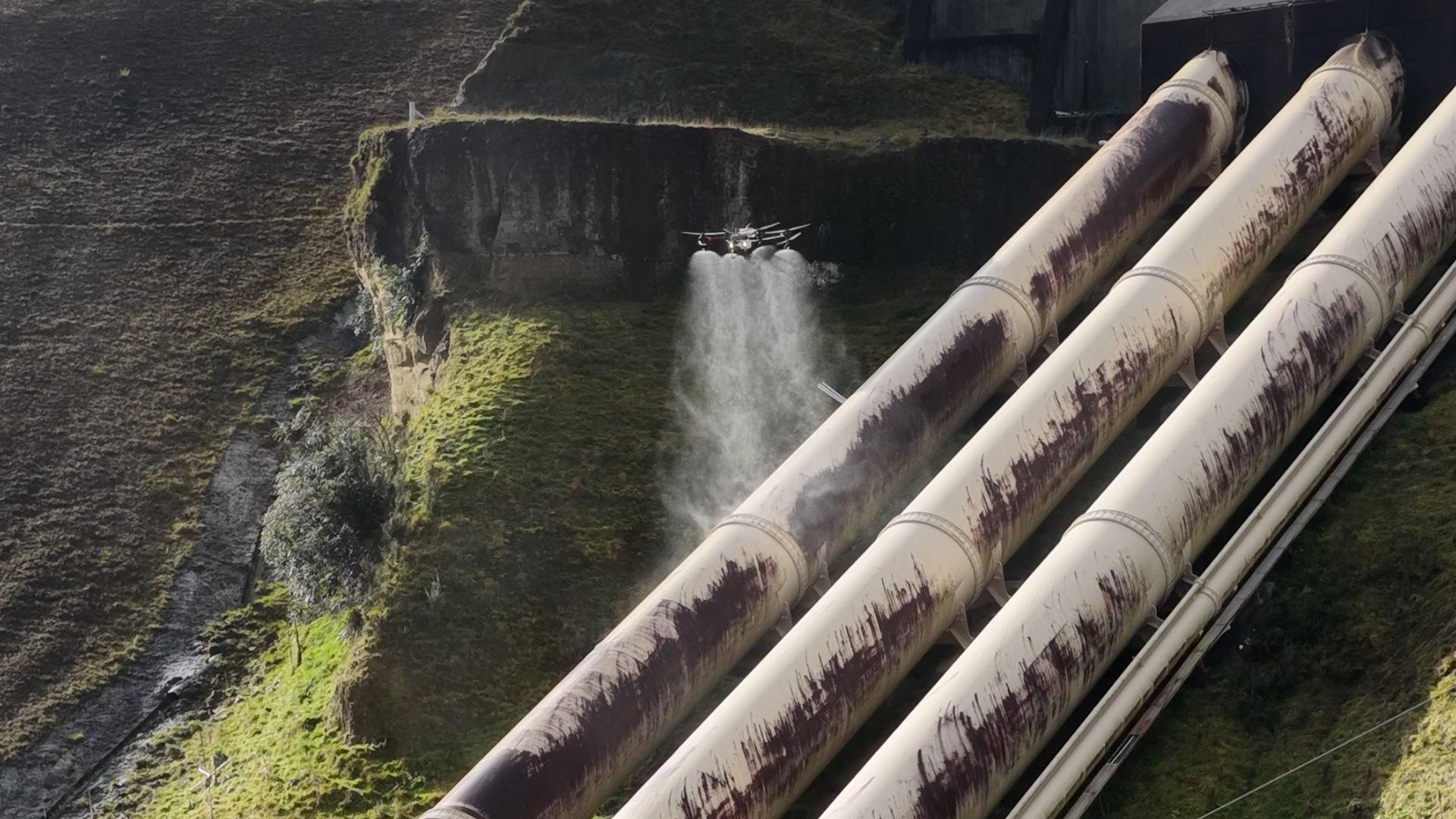
Pro Vision deployed an agricultural spray drone to treat selected areas within the paddock rather than broadcasting chemical across the entire site.
The drone’s flight path and spray system allowed the team to target individual sections with a high level of accuracy while maintaining separation from waterways and native bush.
The aircraft’s downward airflow also helped move the spray into and beneath the vegetation.
As the client observed:
“Looking up the hill, it was amazing. You could see the gorse really getting blasted underneath with the downforce.”
This gave the team confidence that the treatment was reaching the target plants rather than simply settling on the upper surface.
Traditional spraying methods can make it difficult to isolate small or irregular treatment areas, particularly across steep farmland.
The drone provided a more controlled alternative, enabling Pro Vision to apply spray only to the vegetation that needed treatment.
This accuracy was especially valuable around environmentally sensitive areas.
“It’s so important that we can specifically target certain crops and stay away from waterways and native bush.”
Rather than treating the full paddock, the team was able to identify and spray only the affected areas.
The paddock covered approximately 10 hectares, but only two hectares required treatment.
Using a helicopter would have meant broadcasting spray across the entire paddock. The drone operation reduced the treated area by around 80 per cent.
This delivered an immediate saving in chemical costs while avoiding unnecessary application across productive pasture.
Selective spraying also allowed the client to preserve clover growing throughout the paddock.
A blanket helicopter application would likely have removed the clover along with the targeted vegetation. By spraying only the affected sections, the remaining pasture was left untreated.
The client estimated that the retained clover still had the potential to remain productive for a further two years.
This meant the drone operation supported both the immediate weed-control objective and the longer-term productivity of the paddock.
Pro Vision successfully treated approximately two hectares within a 10-hectare paddock.
The operation:
The project showed how agricultural drones can provide a practical alternative to broadacre spraying when accuracy and selective application are priorities.
Spraying is only one potential use for agricultural drone technology.
The same platforms can be used across flat, steep and difficult terrain for a range of applications, including:
As the technology continues to improve, agricultural drones are becoming an increasingly versatile tool for precise and efficient land management across New Zealand.